---------------------------------------
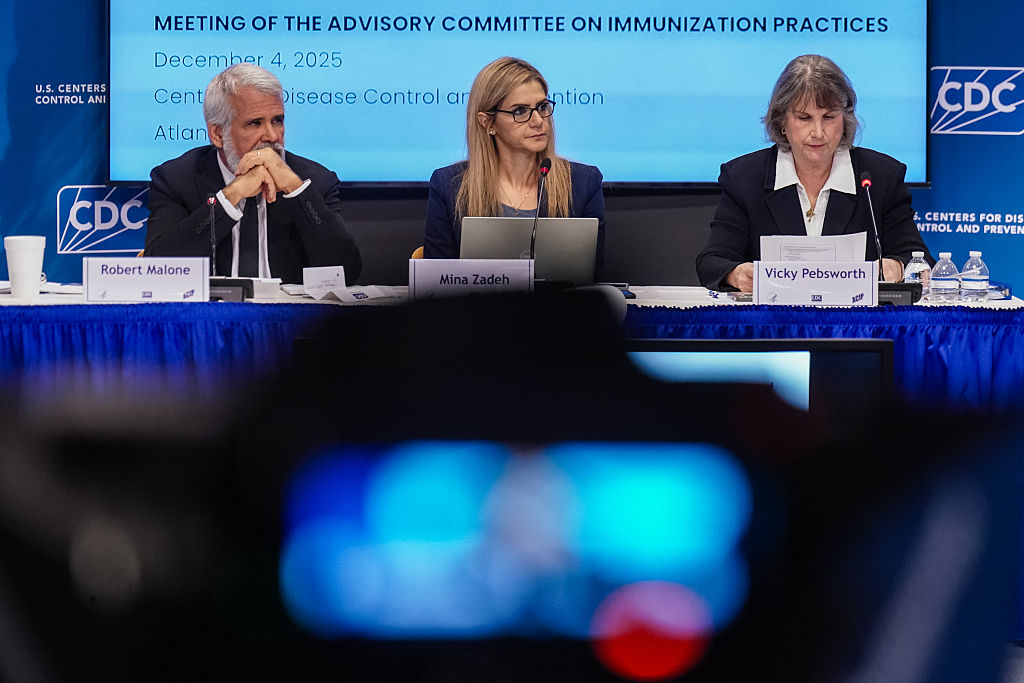
A committee of the U.S. Centers for Disease Control and Prevention (CDC) tasked with advising the country on vaccines voted to remove a decades-long recommendation for the hepatitis B vaccine for newborns.
On Dec. 5, the CDC’s Advisory Committee for Immunization Practices (ACIP) voted 8 to 3 to eliminate the first dose of hepatitis B vaccine that has been recommended for all newborns since 1991. It now recommends the birth dose only for mothers who are positive for hepatitis B or whose hepatitis B status isn’t known, and in remaining cases, leaves families and doctors to decide when to administer that dose. The committee also voted to allow “shared decision-making” about whether babies receive all three doses of the vaccine. Currently, CDC recommends babies get vaccinated for hepatitis B within 24 hours of birth, then when they are one to two months old, and finally at six to 18 months.
[time-brightcove not-tgx=”true”]
The decision led to immediate pushback from infectious-disease and public-health experts. “The ACIP recommendation to end the universal birth dose of the hepatitis B vaccine puts millions of American children at greater risk of liver damage, cancer and early death,” said Dr. Tom Frieden, former CDC director and president and CEO of Resolve to Save Lives, in a statement. “Now obstetricians, pediatricians, insurers, state health departments and others should stand up for fact-based care, protect our children, and not mess with success—not accept this misguided and dangerous recommendation.”
A group of several dozen professional medical organizations and health advocacy groups, including the American Medical Association and the March of Dimes, released a joint statement expressing alarm over the committee’s decisions. ““This is a significant departure from the historic role ACIP has played in shaping vaccine policy in the United States,” it said. “Previously, we could expect science to drive decisions, experts to debate evidence, and consensus to lead to shared, clear recommendations. That is not the case with the current committee, and this change puts Americans’ health at risk.”
Here’s what to know about the hepatitis B vaccine and what the new recommendations, if adopted by the CDC, could mean.
What is the current recommendation for hepatitis B vaccination?
The original recommendation for a birth dose and two additional doses of the hepatitis vaccine was based on data showing that three doses are highly effective in protecting, throughout a person’s lifetime, against the virus and the conditions that infections can cause, including liver failure, liver cirrhosis, and liver cancer. Data from the CDC show that if newborns don’t get vaccinated and then get infected with hepatitis B in their first year of life, up to 90% can develop a chronic infection, which significantly increases the risk of those liver conditions. Among those with chronic infections, up to 25% will die from infection-related issues. When pregnant women have hepatitis B, anywhere from 70% to 90% of their babies (who do not get the vaccine at birth) get infected.
Since the U.S. began recommending universal hepatitis B vaccination in 1991, rates of the infection have dropped by 99%.
Why did the CDC committee decide to reconsider the hepatitis B vaccine’s safety and schedule?
The ACIP has changed dramatically under Robert F. Kennedy Jr., Secretary of Health and Human Services, which oversees the CDC. In June, Kennedy removed all existing members of ACIP, who are volunteers and provide their expert advice to the CDC, and replaced them with people who share his skepticism on the safety and effectiveness of vaccines.
That perspective was reflected in the fact that the newborn dose was even a topic of discussion, despite what many public-health and infectious-disease experts say is solid evidence supporting its safety and effectiveness.
Read More: We Aren’t Ready for the Next Pandemic. This Game Proves It
The ACIP meeting, which occurred over two days on Dec. 4 and 5 was marked by an often-contentious back and forth among those with differing points of view. “It made me very sad to see that this is where things are going,” says Dr. Helen Chu, an infectious-disease specialist at the University of Washington School of Medicine and former ACIP member. “It wasn’t so much a scientific discussion of the evidence that could benefit the American public, but a forum for the discussion of falsehoods.”.
Is the hepatitis B vaccine safe?
Committee members raised questions about the vaccine’s potential effect on the brains of newborns and their development. Many members also questioned the policy of vaccinating all babies, regardless of their risk or whether their mothers were infected. But the three members who opposed the change noted that there was little evidence of any harm from the vaccine, even among newborns, and that no longer vaccinating newborns would increase the harm for children who would become vulnerable to dangerous liver conditions.
“There is plenty of evidence of efficacy and no evidence in regard to lack of safety,” said ACIP member Dr. Cody Meissner, professor of pediatrics at Dartmouth Geisel School of Medicine, who voted against removing the newborn dose. “This disease has become a victim of the vaccine; we are seeing disease rates go down because of the effectiveness of the vaccine. That doesn’t mean the virus has gone away. It means the vaccine is working effectively. It’s a mistake to say that because we are not seeing so much disease, we can alter the frequency or schedule of administration. We will see hepatitis B infections come back. It does not make sense in my mind to change the immunization schedule.”
“I agree that we do not have exactly all the data that we would like to have in order to make decisions,” said Dr. Joseph Hibbeln, a psychiatrist and former chief of nutritional neurosciences at the National Institutes of Health, who also voted against the change. “That’s the nature of science. We have to make decisions with the data we have, and we must use only credible data to make decisions and not speculations and hypotheses—things like deciding or commenting on delaying the first dose to three months because there may be differences in babies’ blood-brain barriers that are not fully developed, or that there may be possibilities of harms we don’t know. Those are all speculations, and those are all hypotheses. They are not data based.”
Read More: We’re Even Less Prepared For the Next Pandemic After COVID-19, Expert Warns
Dr. Wilbur Chen, professor of medicine at the University of Maryland School of Medicine, who was one of the former ACIP members Kennedy removed in June, says that committee members promoted their own skeptical views on vaccines and that no new or additional evidence was presented to question the safety or effectiveness of the newborn hepatitis B vaccine dose. “Some people on the ACIP are looking for a bogeyman and say we haven’t done enough studies to find [safety issues],” he says. “Well, you’re also not going to find something if it doesn’t exist. We have had multiple decades to look for a [safety] signal, and we haven’t found it.”
He says vaccine skeptics are sowing distrust and raising misleading concerns about a lack of data. “It’s a very sleight-of-hand move to throw out that there is not enough information on the safety of vaccines,” Chen says. “There will never be enough information for them. If we do provide the data, they will move the goal line.”
During the meeting, Meissner echoed that perspective, noting that “there will always be something that you want to worry about if you look hard enough. I just don’t understand what people are worried about if we deviate from the current recommended immunization schedule, which the CDC has shown is beneficial and with no evidence of harm.”
How might the three-dose hepatitis B vaccination schedule change?
The most potentially confusing recommendation from ACIP involves how many doses of the hepatitis B vaccine children should receive. The members discussed the metrics that doctors use to determine whether people are protected by the vaccine—the level of antibodies they generate—and whether fewer vaccine doses would be justified. Doctors have historically measured levels of the hepatitis B antibody about a month or two after the third dose of the vaccine, but members questioned whether, if infants are tested and reach the adequate levels of antibodies after the first or second dose, additional doses would no longer be needed.
Adam Langer, an epidemiologist at CDC who is an expert on hepatitis B, told the members during the meeting that using such a strategy wasn’t necessarily scientifically sound. “We are making a really huge assumption that one dose that happened to get a baby’s [antibody] titer [to a certain level] was in fact lifetime protective, and there is no reason not to give the full series of three doses,” he said. “There is no evidence of any significant long-term adverse events that occur with giving the full series. And there is certainly no evidence to suggest any less risk in giving one or two rather than three doses.”
Dr. Jim Campbell, vice chair of the Committee on Infectious Diseases at the American Academy of Pediatrics (AAP), says that the new recommendations will make it more confusing for doctors and families to make decisions about the hepatitis B vaccine. Parents could, theoretically, get a blood test for their babies a month or so after every dose to determine if they have made enough antibodies before deciding to get them the next dose. But that requires more doctors’ visits, needle pricks, and blood work. In addition, childhood vaccinations against different diseases often come bundled together, so if parents decide not to get the following dose, their pediatrician may not be able to accommodate the request because they don’t carry separate hepatitis B vaccine doses.
“It’s going to be very difficult and may mean that families will have to go to different [pediatric] practices in order to get their child vaccinated [for other diseases] if they want to forego a hepatitis B dose,” Campbell says. “There is no scientific basis for this recommendation, and it will be logistically very difficult.”
Do other countries recommend a dose of hepatitis B vaccine at birth?
The World Health Organization recommends the birth dose of the hepatitis B vaccine, as do more than 100 countries. However, some ACIP members questioned why some countries, like the U.S., follow the policy, and why others like Denmark do not.
But Langer, the CDC epidemiologist, pointed out that comparing the U.S. to Denmark is problematic since the health systems and extent of testing for the virus vary in the two countries. “We don’t have a peer-nation in this world,” Langer said. “More than 95% of pregnant women in Denmark are screened for hepatitis B, and prenatal care is free for both citizens and refugee or asylum seekers in Denmark. We all know that is not the case in the U.S.”
Will the changes to hepatitis B affect other childhood vaccines?
The two-day meeting ended with a discussion of the broader childhood vaccination schedule, as Kennedy has indicated he wants to reshape it in favor of giving parents more autonomy to decide whether to vaccinate their children against any disease. The primary presenter was Aaron Siri, a vaccine-injury attorney whose firm is currently suing HHS on behalf of clients whose children they claim were injured by vaccines. (Siri has also been Kennedy’s attorney.) “I don’t think you should have been invited, to be completely honest,” Meissner said after Siri’s lengthy presentation. Meissner took issue with how Siri interpreted certain vaccine data, saying “you are an effective lawyer, you’re very smooth and know how to present facts that are favorable to you or your client. But for you to come here to make absolutely outrageous statements about safety is a big disappointment to me.”
Read More: For the First Time This Century, Child Mortality Is Likely to Rise
Meissner pointed out that Siri “clearly confuse[s] associations. There are temporal associations and causal associations. Just because an adverse event occurs around the time a vaccine is administered doesn’t mean there is any causal association,” he said. “You’re jumping to the conclusion that, yes, there is. That is not fair.”
ACIP leadership said that other experts, including former ACIP member Dr. Paul Offit from Children’s Hospital of Philadelphia, were invited but “elected not to present.” Offit tells TIME that he received a vague request in October to speak at the CDC about vaccines, and did not respond because more details weren’t provided. “I didn’t know what it was about,” he says, noting that his lack of response isn’t equivalent to declining to participate.
Many professional organizations, including the American Academy of Pediatrics, have decided to no longer join ACIP meetings because of the new members’ biased view on vaccines. The AAP and other medical organizations continue to recommend the newborn dose of the hepatitis B vaccine, and Campbell says the group has no intention of revisiting that recommendation because there is no new data to justify any change.
What happens next?
The committee’s recommendation now goes to the acting director of the CDC, Jim O’Neill, who was appointed after the previous director, Susan Monarez, was fired by President Trump after refusing to follow Kennedy’s new policies on vaccines, including no longer recommending annual COVID-19 shots for healthy people. Senator Bill Cassidy, a Republican from Louisiana and a physician, urged O’Neill to reject ACIP’s recommendations. “As a liver doctor, who treated patients with hepatitis B for decades, this change to the vaccine schedule is a mistake,” he posted on X on Dec. 5. “The hepatitis B vaccine is safe and effective. The birth dose is a recommendation, NOT a mandate,” he wrote, noting that the current policy still allows parents to make a decision about whether to vaccinate their newborns or not. “Acting CDC Director O’Neill should not sign these new recommendations and instead retain the current, evidence-based approach.”
ACIP’s decisions, while seeming to allow for more “shared decision making” around vaccinations, will only increase confusion and will likely lead to higher rates of preventable diseases, say public health experts, without appreciably changing the choice that parents already have. Campbell notes that current vaccination policies are not mandates but recommendations, and that families ultimately make the final choice about whether to vaccinate their children or not. But introducing another layer of testing and dosing regimens will add additional logistical and financial burdens to families.
On the public-health side, the changes will likely increase infection rates, as vaccine coverage drops and discord between federal health policies and those of medical organizations leads states to craft their own vaccination guidelines. Already, some states have responded to CDC’s decision to no longer recommend an annual COVID-19 vaccine by recommending it in their states and supporting insurance coverage for it as well. Such division will only continue with changes like the ones to the hepatitis B vaccine, with the ultimate result being differing rates of disease across the country, experts worry. Currently, rates are low for most preventable diseases nationwide.
“We are not the United States of America any more,” says Chen of the vaccination policy. “Vaccination is getting more and more complex, and states can no longer depend on the federal system because of the way the leadership has dismantled the ability to trust even the CDC.”
“Infectious diseases are not political,” he adds. “This should not be a political question.”
-----------------------------------------
By: Alice Park
Title: A New CDC Recommendation Could Mean a Big Change for Childhood Vaccines
Sourced From: time.com/7339072/cdc-committee-acip-hepatitis-b-vaccine/
Published Date: Sat, 06 Dec 2025 00:47:13 +0000
Read More
Did you miss our previous article...
https://prohealthsciences.com/general-health-and-wellness/slaying-the-dragon
 General Health and WellnessFitness and ExerciseSupplements and VitaminsPandemic NewsVideosPrivacy PolicyTerms And Conditions